
Brisbane Property Intelligence | September 2026
Brisbane's market has shifted. But the shift isn't uniform, and that matters for investors.
Brisbane's property market has moved into a distinctly different phase.
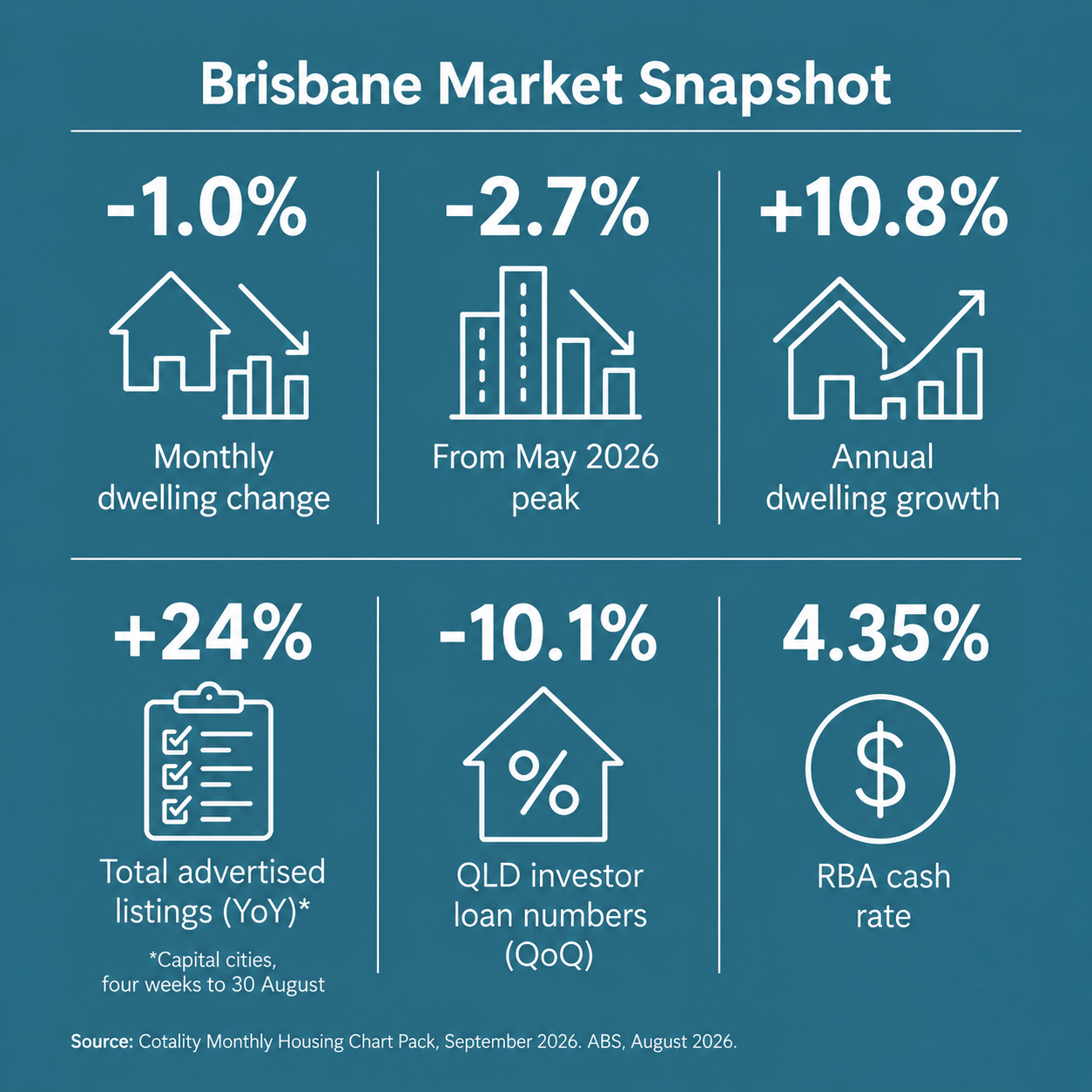
After several years of strong growth, dwelling values fell 1.0% in August, following declines in the preceding months. Brisbane values are now around 2.7% below their recent peak, although they remain substantially higher than a year ago.
The shift is also becoming more widespread. Across Australia's capital cities, Cotality reports that 93% of suburbs recorded a decline in values through winter, up from 45.8% through autumn.
But the headline decline doesn't tell us everything about Brisbane.
Properties are taking longer to sell, buyer urgency has reduced, and vendor expectations are adjusting. At the same time, different price points and property types are responding differently, rental conditions remain tight, and Queensland's development pipeline continues to attract activity.
For investors, that makes the current market less about whether Brisbane is simply going "up" or"down" and more about understanding where the opportunities—and the risks—are emerging.
Brisbane's downturn is becoming more established
The latest Cotality Home Value Index shows national dwelling values fell 0.9% in August, marking a fifth consecutive monthly decline.
Brisbane recorded a 1.0% monthly fall, compared with 1.4% in Sydney and 1.1% in both Melbourne and Canberra. Adelaide and Perth were down 0.8%.
More importantly, the downturn is no longer confined primarily to the premium end of the market. Cotality says higher-value housing is still generally recording larger declines, but the gap between the upper and lower quartiles is narrowing as softer conditions become more widespread.
That's a change from what we were seeing only a few months ago.
In Episode 3 of Brisbane Property Pulse, we discussed the relative resilience of Brisbane's lower-priced market, where affordability was helping to concentrate investor and first-home-buyer demand. The latest data suggests those conditions are continuing to evolve.
Affordability continues to influence where buyers are looking, but lower-priced property is becoming less insulated from the broader slowdown.
For investors, it reinforces an important point: Brisbane isn't one property market.
Performance can vary significantly between suburbs, price points and property types, and a city-wide median should never be considered in isolation when assessing an individual investment.
What's driving the change?
The shift in market conditions hasn't happened in isolation. Higher borrowing costs are influencing borrowing capacity, buyer confidence and the level of demand.
The Reserve Bank of Australia held the cash rate at 4.35% in August, following three increases totalling 75 basis points during 2026. The RBA described financial conditions as "somewhat restrictive", with higher borrowing costs working to slow demand.
Housing finance data shows the impact.
The latest ABS Lending Indicators show the number of new dwelling loan commitments fell 5.4% in the June quarter. Investor loan commitments fell 8.6%, while owner-occupier lending fell 3.3%. In Queensland, investor loan numbers fell 10.1% over the quarter.
Importantly, this isn't simply a story about investors abandoning property. Investor loan numbers nationally were still 2.8% higher than a year earlier.
Rather, borrowing capacity, higher holding costs and changing sentiment are influencing how much investors can spend, where they're looking and how quickly they're prepared to act.
Buyers have more choice, but not because listings are surging
This is an important distinction in the current data.
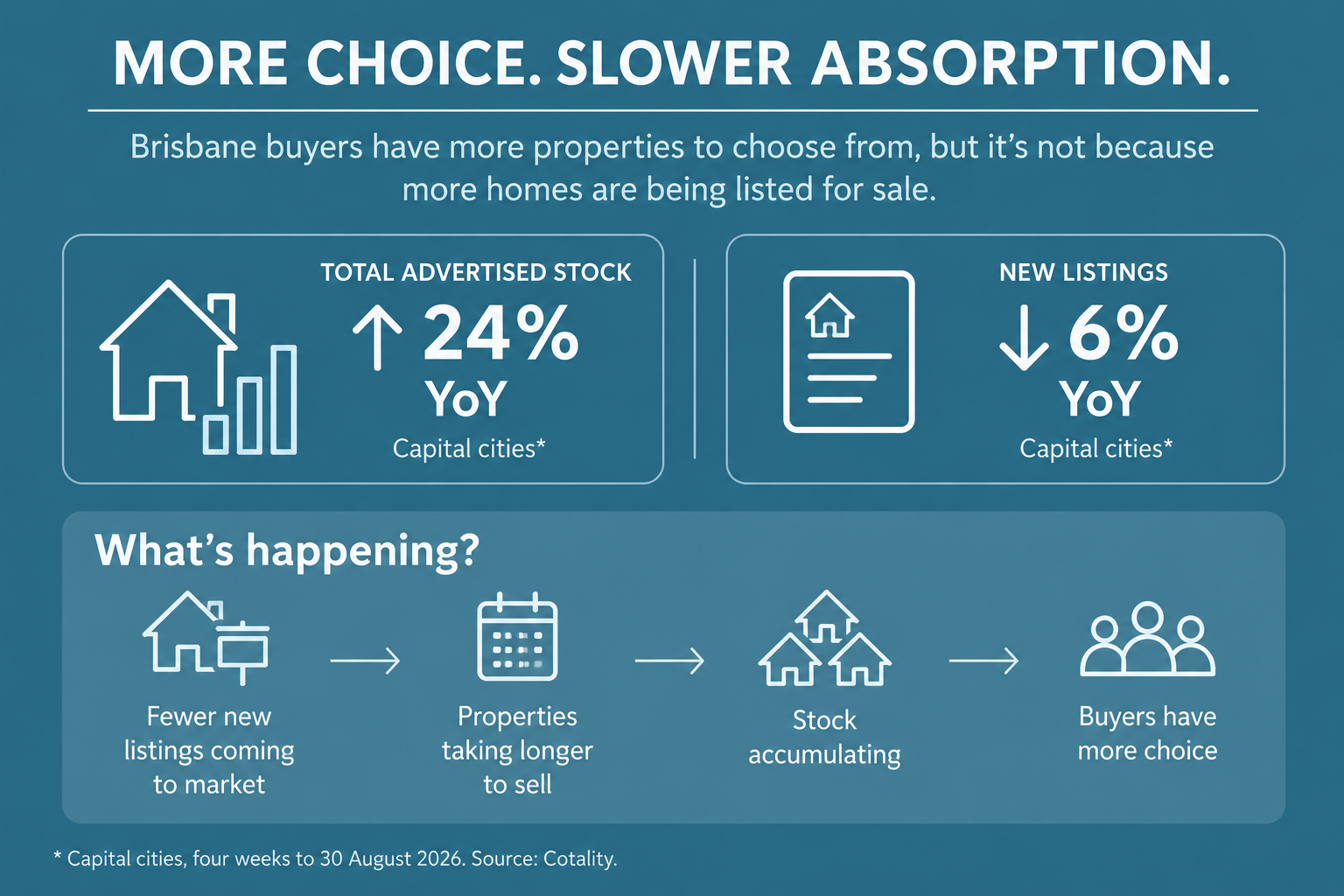
Across the capital cities, total advertised stock was 24% higher than a year ago in the four weeks to 30 August. Yet the flow of new listings was actually 6% lower than a year earlier and 8% below the five-year average.
In other words, higher stock levels aren't simply the result of a surge in owners deciding to sell.
Properties are accumulating because they are taking longer to sell.
Cotality describes this as a slower rate of absorption: weaker transaction activity means properties remain advertised for longer, giving buyers more stock to choose from even though fewer new listings are entering the market.
That distinction is particularly relevant in Brisbane.
Cotality estimates Brisbane is among the capital cities to have recorded the largest falls in transaction activity, with sales volumes down more than 20% compared with a year ago.
This is not necessarily a market flooded with sellers.
It's a market where buyers are taking longer to act.
What we're seeing on the ground
The change is increasingly evident in our day-to-day negotiations.
Selling agents are approaching us more frequently with off-market opportunities, buyers generally have more time to complete their research and due diligence, and we're seeing greater scope to negotiate when vendor expectations haven’t adjusted to current conditions.
In Episode 3 of Brisbane Property Pulse, we discussed what we were seeing through our agency relationships, including a significant increase in the number of off-market opportunities being presented to us. We were also seeing agents proactively approaching us to determine whether we had buyers for properties before, or alongside, formal sales campaigns.
This is Investeps' experience rather than a Brisbane-wide measure, but it provides useful context for what the broader market data is now showing: properties are taking longer to sell, and the balance between buyers and vendors is shifting.
The urgency that characterised the strongest stages of Brisbane's recent growth cycle has reduced.
That can give investors something that was often in short supply during a rapidly rising market: time.
Time to research the property properly. Time to understand comparable sales. Time to complete due diligence. And, in some cases, time to negotiate.
Why current transaction evidence matters
Published property data remains an essential part of understanding market conditions, but there is inevitably a timing lag.
A property can be negotiated today and take several weeks to settle. That means current changes in buyer behaviour and negotiated prices can take time to flow through to published sales evidence.
This has become particularly relevant when we’re assessing value for clients.
During rapidly rising markets, a property could reasonably sell above the settled comparable evidence because the market had moved ahead of those previous transactions.
We're now seeing the reverse in parts of Brisbane.
Settled sales may support one value, while more recent negotiations—including transactions that have occurred but haven't yet settled—can indicate that buyers are achieving lower prices.
As Curtis and Trent discussed in Episode3 of the Brisbane Property Pulse, settled sales remain an important form of evidence, but combining them with an understanding of very recent transactions can provide a more current picture of where buyers and sellers are actually meeting.
For investors, that's one reason local market intelligence becomes particularly valuable when conditions are moving quickly.
Development tells another side of the Brisbane story
While the established housing market has softened, development activity provides an interesting counterpoint.
The August Cordell Construction Monthly shows the number of new projects identified in Queensland over the 12 months to July was 12.3% higher than during the preceding 12-month period. Nationally, apartments and units were one of only two sectors to record an increase in new projects over that period.
That aligns with what we're seeing directly.
Developer clients we're working with continue to look for sites, including higher-density opportunities and locations around Moreton Bay. Feasibility and the ability to acquire the right site at the right price remain critical, but development activity hasn't stopped simply because established dwelling values have softened.
That doesn't mean development activity is a proxy for future house-price growth. It does, however, provide another indication that the Brisbane and broader Queensland property story is more nuanced than the headline value declines alone suggest.
A softer market doesn't automatically create better investments
For investors, perhaps the most important change is the negotiating environment.
Less urgency, longer selling periods and reduced transaction volumes can provide buyers with greater leverage.
But more negotiating power doesn't make every property a good investment.
A property bought below an owner's initial expectation isn't necessarily good value. Likewise, a property sitting on the market for an extended period may represent an opportunity, or there may be a very good reason other buyers aren't interested.
When broad market growth slows, property selection arguably becomes more important, not less.
Location, land characteristics, zoning, future supply, buyer appeal, rental demand and the price paid all matter. So does understanding how the particular suburb and property type are performing rather than relying on Brisbane's headline median.
What does this mean for Brisbane property investors?
Brisbane has clearly shifted from the conditions that characterised the past several years.
Values are falling. Transaction volumes have reduced. Properties are taking longer to sell. Higher borrowing costs are constraining demand, and Cotality's latest figures show the downturn becoming more widespread.
But that doesn't make the current market inherently good or bad for investors.
It makes it different.
For finance-ready investors, reduced competition may create more time to assess opportunities and greater scope to negotiate. But when broad market growth is no longer lifting properties equally, asset selection becomes even more important.
Rather than trying to predict the exact bottom of the Brisbane market, the focus should be on identifying individual properties where the fundamentals, price and long-term strategy stack up.
Changing market conditions don't change what makes a quality property. But they can change the price, competition and terms under which you're able to acquire one.
That's where we believe the opportunity in Brisbane's current market lies.



-min%20(1).webp)