
Brisbane Property Intelligence | July 2026
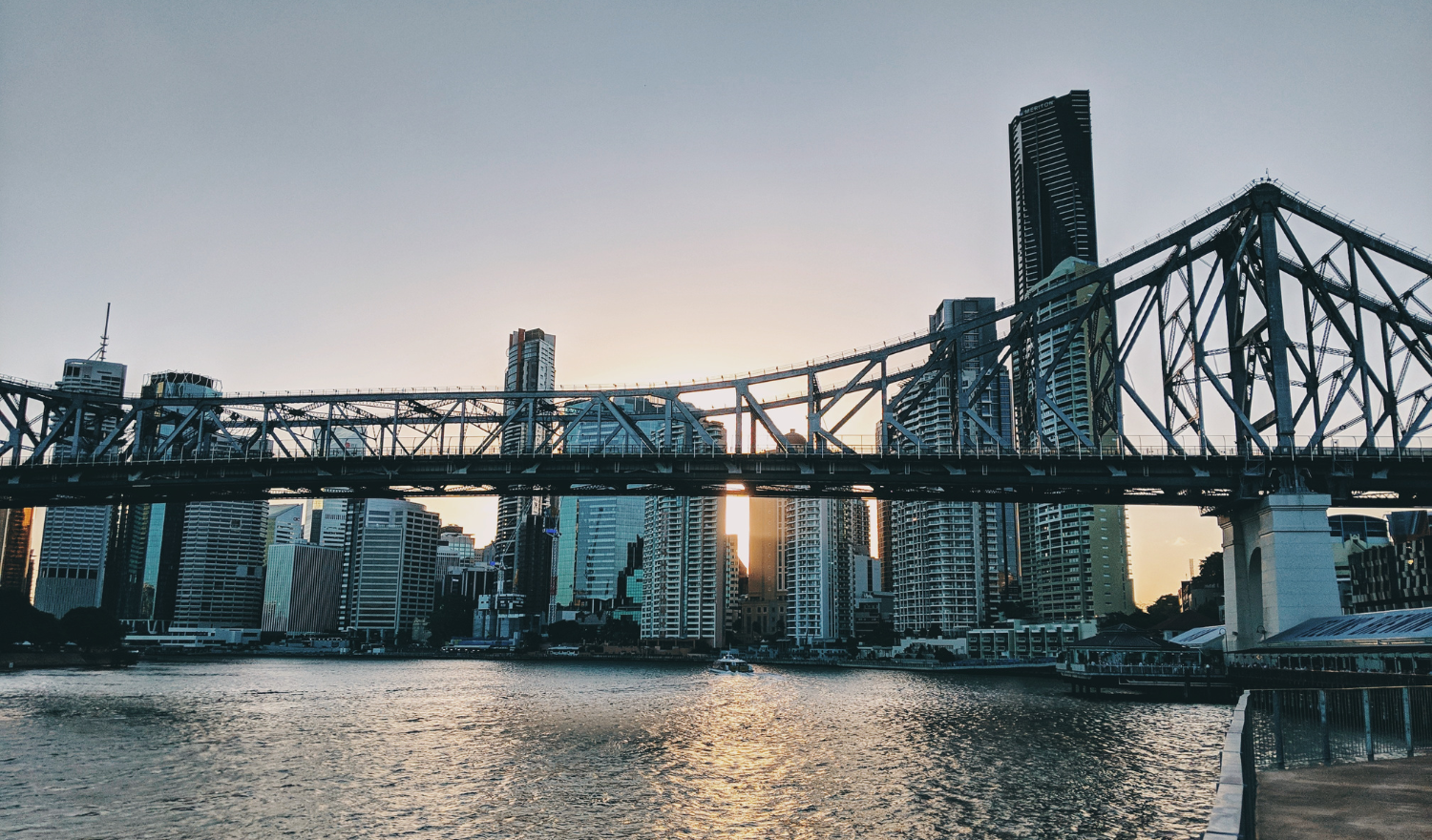
Brisbane's growth story isn't over, but the market is becoming far more interesting.
After two years of exceptional price growth, Brisbane is entering a different phase.
The city remains one of Australia's strongest-performing housing markets, yet the broad-based surge that lifted almost every suburb is beginning to give way to something more selective. In many ways, it's a sign the market is maturing.
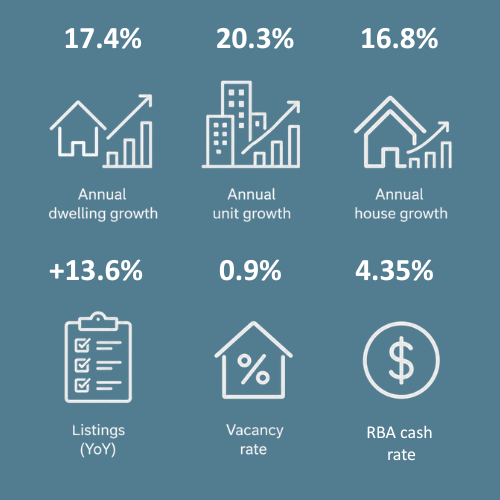
Annual dwelling values remain up 17.4%, one of the strongest performances of any Australian capital city. Units have quietly become the standout performer, recording 20.3% annual growth while also delivering stronger rental yields than detached houses. At the same time, the number of properties available for sale has increased by 13.6% over the past year, giving buyers more choice than they have enjoyed for some time.
On the surface, those numbers appear contradictory.
How can a market continue producing double-digit annual growth while buyers are suddenly finding more properties to choose from?
The answer lies in understanding where demand remains strongest, rather than assuming the entire market is moving together. That's where working with an experienced Brisbane buyers agent can make the difference between following the market and identifying quality opportunities before they become widely recognised.
Brisbaneis no longer behaving like a market where every suburb and every property type rises at the same pace. Some locations continue to experience exceptionally strong buyer demand, while others are beginning to respond to improved supply and changing affordability.
This is where the market becomes more interesting.
For much of the past two years, success often came down to acting quickly. Today's market feels different. Buyers have more opportunity to compare properties, undertake due diligence and ocus on quality rather than simply competing for limited stock. That's a healthy evolution for Brisbane's property market and one that is likely to reward informed decision-making over the months ahead.
When almost every suburb was rising quickly, it was easy to mistake momentum for quality. As growth begins to normalise, the characteristics that define investment-grade property become much easier to identify, and much more important.
The latest Cotalitydata reflects this transition. While Brisbane recorded a modest 0.3% increase in dwelling values during June, annual growth remains among the strongest in the country. Rather than signalling weakness, the data suggests the market is moving from rapid, broad-based growth to a more balanced phase where performance is increasingly influenced by location, property type, and buyer demand.
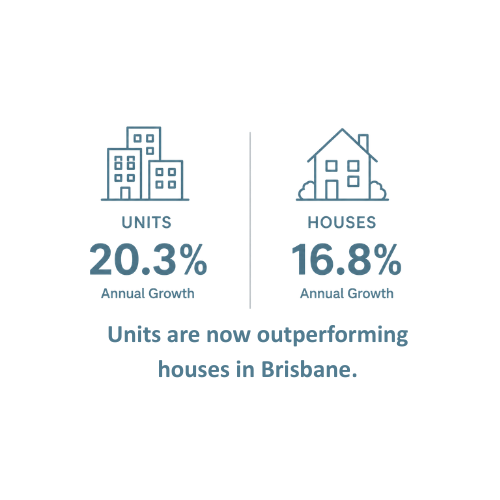
One of the clearest examples of the market becoming more selective is the continuedstrength of Brisbane's unit market.
Over the past 12 months, units have outperformed detached houses, recording 20.3%annual growth compared with 16.8% for houses. While affordability has certainly played a role, the shift is being driven by several factors working together.
As Brisbane's median house price has continued to climb, many buyers have turned to apartments and townhouses as a more accessible pathway into established suburbs. At the same time, government initiatives such as the First Home Guarantee have expanded access to home ownership for eligible buyers, increasing competition in parts of the market that have traditionally appealed to both first-home buyers and investors.
Strong population growth, exceptionally low vacancy rates and continued rental demand have added further support to quality unit markets.
Importantly, the headline growth figures don't tell the whole story.
Performance has not been consistent across every part of Brisbane's apartment market. Well-located, established units with strong owner-occupier appeal have generally continued to outperform, while areas with significant new apartment supply have experienced more varied conditions.
For investors, that's an important distinction. It's a reminder that broad market trends don't automatically translate into strong performance for every property. As Brisbane's market matures, careful asset selection is becoming increasingly important.

Another notable shift is the increase in available listings.
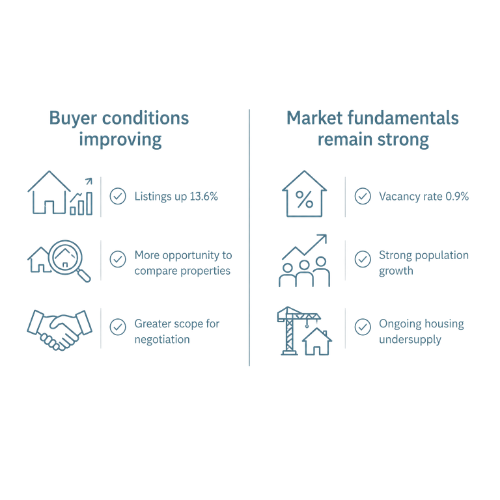
Properties advertised for sale across Brisbane are now 13.6% higher than they were a year ago, giving buyers more choice than they have experienced throughout much of the recent property cycle.
While rising listings are sometimes interpreted as a sign that the market is slowing, the broader data suggests a more balanced picture.
Quality properties continue to attract strong competition, but buyers now have a greater opportunity to compare assets, undertake thorough due diligence and negotiate with greater confidence than they could during the exceptionally tight conditions of the past two years.
Importantly, higher listing volumes should not be confused with oversupply.
Brisbane's rental market remains exceptionally tight, with a vacancy rate of approximately 0.9%, while Queensland continues to experience strong population growth and an ongoing shortage of new housing. These structural factors continue to support the market, even as conditions become more balanced.
For investors, this changing environment presents a different type of opportunity.
The conversation is becoming less about simply gaining exposure to the Brisbane market and more about selecting assets with the characteristics most likely to support long-term performance.
Markets driven by rapid momentum often reward speed. Markets entering a more balanced phase tend to reward research.
Understanding factors such as owner-occupier demand, transport connectivity, infrastructure investment, land scarcity, future housing supply and local employment drivers becomes increasingly important when performance is no longer uniform across every suburb or property type.
These fundamentals have always mattered. The difference today is that they are becoming easier to recognise, and increasingly important in separating quality investment opportunities from average ones.
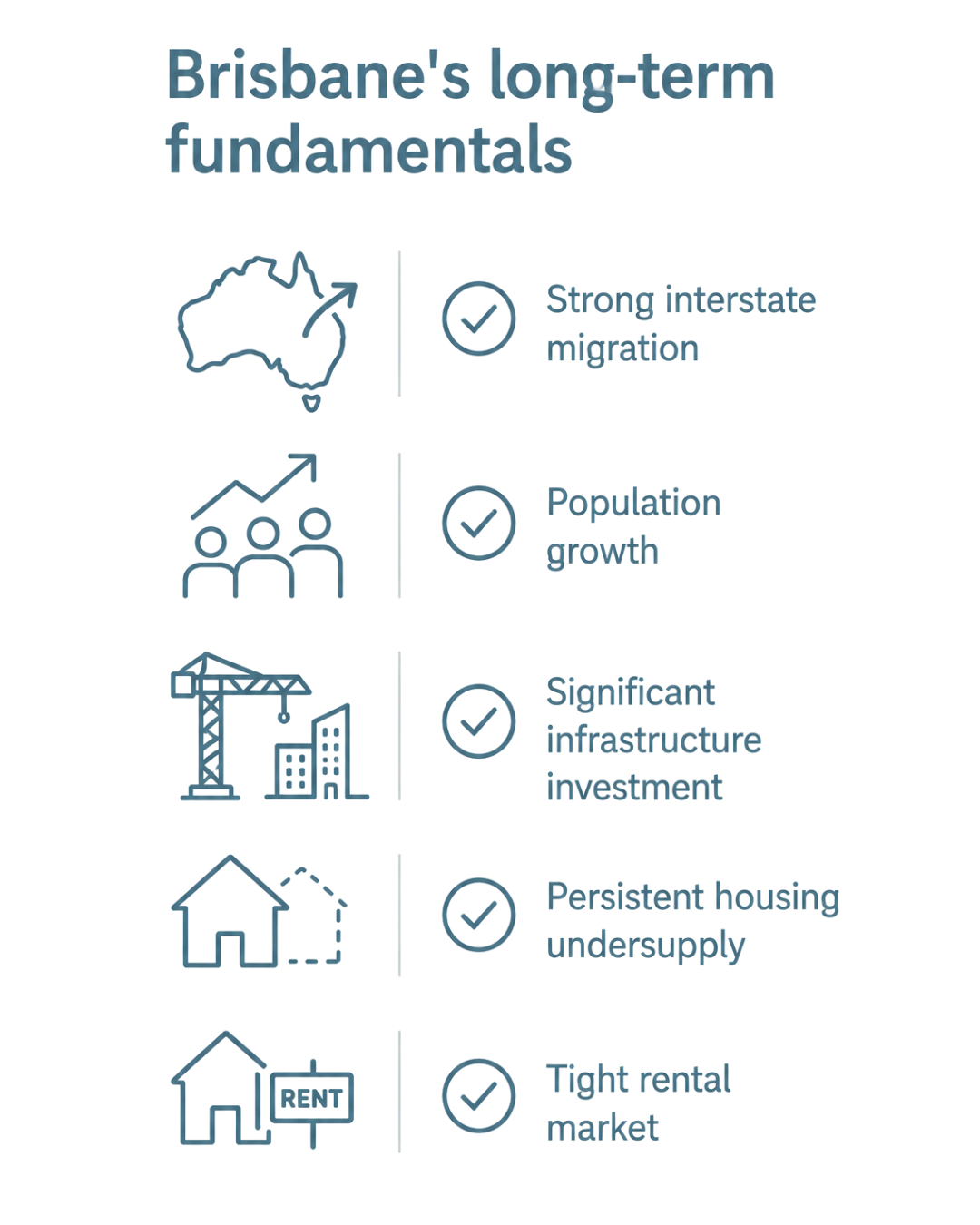
Brisbane's long-term outlook remains compelling.
The city continues to benefit from strong interstate migration, sustained population growth, significant infrastructure investment and persistent housing undersupply. These are not short-term drivers. They are structural trends that have supported Brisbane's performance over recent years and are likely to continue influencing the market well beyond the current property cycle.
While monthly market updates will continue to fluctuate, the broader story remains remarkably consistent.
Brisbane's growth story isn't over.
It's simply becoming more selective.
For informed investors, that's often when understanding the market becomes every bit as valuable as participating in it. As a buyers agent Brisbane investors trust, Investeps focuses on identifying investment-grade properties backed by long-term fundamentals rather than short-term market momentum.
Sources
- Cotality) Housing Chart Pack – June 2026
- SQM Research
- Reserve Bank of Australia
- Australian Bureau of Statistics
- Queensland Government housing and population data


-min%20(1).webp)