
Brisbane Property Intelligence | August 2026

Brisbane’s momentum has slowed, but the market is far from one-dimensional.
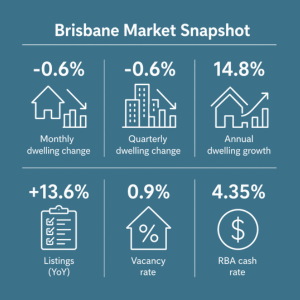
Source: Cotality Housing Chart Pack (August 2026), SQM Research and Reserve Bank of Australia.
After more than two years of exceptional growth, Brisbane has entered a different phase.
The latest Cotality Home Value Index confirms dwelling values declined by 0.6% in July, with revised figures also showing a fall in June. This marks two consecutive months of softer values and signals that the demand pressures affecting the national market have now reached Brisbane.
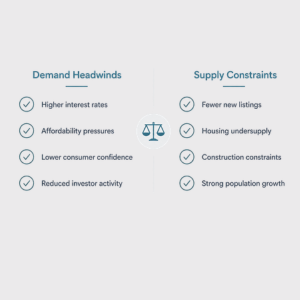
Higher borrowing costs, affordability constraints, weak consumer confidence and reduced investor activity are all weighing on buyer demand. Yet the market is not responding in a uniform way.
Brisbane dwelling values remain 14.8% higher than a year ago, the median dwelling value sits above $1.1 million, and the city is only 0.7% below its recent peak. Units continue to outperform houses, rental conditions remain tight, and several Brisbane, Logan, Ipswich and Moreton Bay markets are still recording strong annual growth.
At the same time, buyers who remain active are seeing greater property choice, longer decision-making periods and improved negotiating conditions. Sellers are also beginning to adjust, with some potential vendors delaying campaigns as market conditions soften.
On the surface, these trends may appear contradictory.
How can values be declining while annual growth remains strong, rental demand stays elevated, and parts of Greater Brisbane continue to outperform?
The answer lies in the balance between weakening demand and constrained supply.
Cotality expects further softness nationally, but it also identifies several factors that may limit the extent of the downturn: low unemployment, continued population growth, restricted new housing delivery and a pullback in new listings as vendors become more cautious.
For investors, that creates a more nuanced market than the headlines suggest.
The opportunity is no longer simply in gaining exposure to Brisbane. It lies in understanding which locations and property types remain supported by enduring demand, and using improved buying conditions to make more considered decisions.
Brisbane Market Snapshot
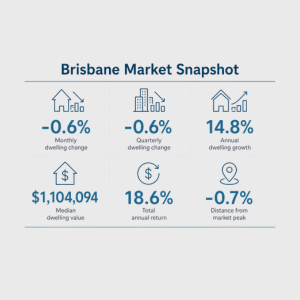
Brisbane’s monthly decline was less severe than the falls recorded in Sydney and Melbourne, where values dropped by 1.4%and 1.2% respectively during July. Brisbane’s annual growth also remains substantially stronger, with Sydney and Melbourne recording annual declines of 2.0%and 2.8%.
This does not mean Brisbane is immune from the broader downturn. It does, however, demonstrate that different markets are entering this period from very different positions.
Brisbane has come off a comparatively recent peak after several years of strong growth. Sydney and Melbourne are experiencing deeper declines and weaker longer-term performance. That distinction matters when interpreting a single month’s result.
What Is Driving the Change?
The current slowdown is not being caused by one factor.
Cotality identifies a combination of pressures that have been building since late 2025:
- affordability and mortgage-serviceability constraints
- 75 basis points of interest-rate increases
- reduced borrowing capacity
- broader cost-of-living pressures
- weak consumer confidence
- lower investor activity following Federal Budget policy changes
- uncertainty surrounding the economic outlook
Together, these factors have reduced the number of buyers who are willing or able to compete at previous price levels.
Interest-rate expectations remain an important part of the outlook. Although the likelihood of further increases has eased and the prevailing view is that the cash rate may be near its peak, Cotality notes that the Reserve Bank retains a tightening bias. The direction of underlying inflation and unemployment will therefore remain important indicators over the coming months.
Consumer sentiment improved by 4.1% in July, although it remains weak by historical standards. Fewer consumers currently believe it is a good time to purchase property than they did during the stronger conditions of late 2025. Because confidence is closely linked to housing turnover, any sustained recovery in buyer activity is likely to depend partly on households feeling more secure about rates, employment and their broader financial position.
Houses and Units Are Responding Differently
Brisbane’s unit market continues to demonstrate greater resilience than detached housing.
During July
- Brisbane house values declined 0.6%
- Brisbane unit values declined 0.4%
Over the quarter:
- House values declined 0.9%
- Unit values increased 0.4%
Over the past 12 months:
- House values increased 14.3%
- Unit values increased 17.1%
Affordability continues to influence this divergence.
With Brisbane’s median house value now approximately $1.21 million, compared with about $875,000 for units, many buyers are broadening their search towards more accessible property types. Units also continue to offer stronger gross yields, at approximately 4.0%, compared with 3.2% for houses.
That does not mean every apartment represents a strong investment.
Performance will continue to vary according to location, building quality, owner-occupier appeal, body corporate costs and the level of future competing supply. However, the latest data reinforces the role that affordability is playing in supporting demand for quality units within established Brisbane suburbs.
Buyer Conditions Are Improving
For buyers who remain active, the current market offers advantagesthat were largely absent during Brisbane’s recent growth cycle.
Cotality notes that lower competition, elevated advertised stock compared with the beginning of the year and increasing time on market are providing buyers with greater choice and stronger negotiating power.
This aligns with what we are seeing on the ground.
Selling agents are engaging qualified buyers earlier, more opportunities are being discussed before formal marketing campaigns begin, and there is greater flexibility around both price and contract terms.
Importantly, this does not mean every property can be purchased at a significant discount.
Well-located homes with strong owner-occupier appeal remain competitive. The difference is that buyers generally have more opportunity to compare properties, complete thorough due diligence and walk away from unsuitable assets without feeling that every opportunity will immediately disappear.
For long-term investors, that is a constructive change.
Markets driven by urgency tend to reward speed. More balanced markets tend to reward preparation, local knowledge and disciplined asset selection.
The Supply Response Matters
One of the most important observations in the latest report is the emerging adjustment in housing supply.
As demand has weakened, many potential vendors have become more reluctant to bring properties to market. Cotality reports a deterioration in the flow of new listings, even as total advertised stock remains elevated because properties are taking longer to sell.
This creates a tension within the market.
Buyers currently have more properties available to compare, but the pipeline of fresh listings may begin to narrow if sellers continue to delay their plans.
At the same time, the delivery of new housing remains constrained by high construction costs and challenges surrounding project feasibility. These limitations are not resolved simply because buyer demand has softened.
Cotality’s assessment is that values are likely to deterioratefurther nationally over the coming months. However, low unemployment, continued population growth, constrained construction and the withdrawal of some vendors reduce the risk of a sharp correction.
For Brisbane, this balance between softer demand and constrained supply will be one of the most important trends to monitor.
Rental conditions remain tight despite the slowdown in dwelling values.
Nationally, rental values increased by 0.4% in July and were 5.9% higher over the year. The national vacancy rate increased slightly to 1.7%, but remains well below its ten-year average of 2.4%.
In Brisbane, annual rental growth remained strong:
- House rents: +6.7%
- Unit rents: +6.2%
- Gross dwelling yield: 3.4%
The rental market continues to provide an important source of support for investors, particularly while housing supply remains constrained.
However, rental affordability is becoming increasingly stretched. Cotality notes that the national median rent has risen by more than $200 per week over five years, leaving households paying a record proportion of income towards rent. This may limit the pace of further rental increases even while vacancy rates remain low.
That reinforces the importance of conservative cash-flow assumptions. Investors should not rely on recent rental growth rates continuing indefinitely when assessing a property’s long-term suitability.
The latest Cotality results alsohighlight significant differences within Greater Brisbane.
Among the strongest-performing SA3markets over the past year were:
- Beaudesert: 20.8%
- Sherwood–Indooroopilly: 20.4%
- Beenleigh: 19.4%
- Nundah: 18.8%
- Springwood–Kingston: 18.7%
- Forest Lake–Oxley: 18.6%
- Loganlea–Carbrook: 18.2%
- Caboolture: 18.1%
- Sandgate: 17.9%
- Springfield–Redbank: 17.8%
The geographic spread of these results is significant.
Strong annual performance is not confined to one corridor or property type. Areas across Brisbane’s west, north,Logan, Ipswich and Moreton Bay continue to record substantial annual growth despite the broader slowdown.
This reinforces why investors should avoid treating Brisbane as a single, uniform market.
Individual locations will respond differently depending on affordability, available supply, infrastructure, employment access and the depth of owner-occupier demand. As momentum becomes less broad-based, these local differences are likely to become more pronounced.
Published data provides animportant view of where the market has been. Active buyer campaigns provide additional insight into how conditions are changing now.
Across Brisbane and South East Queensland, we are seeing:
- stronger engagement from agents seeking qualified buyers
- more opportunities being discussed off-market before public listing
- greater flexibility during negotiations
- longer decision-making periods for buyers
- continued competition for well-located, investment-grade property
These observations are consistent with Cotality’s assessment that active buyers currently have greater choice and negotiating power.
They also highlight why a weaker headline number does not necessarily mean every segment of the market is behaving in the same way.
Average or compromised properties may take longer to sell and require vendors to reconsider their expectations. Quality properties in tightly held locations can still attract multiple interested buyers.
The market is becoming more selective, and that makes property-level analysis increasingly important.
Brisbane’s momentum has clearly slowed, and the latest data should not be understated. Dwelling values have now declined across two consecutive months, buyer demand has weakened, and the national downturn is extending into markets that had previously appeared resilient.
At the same time, Brisbane remains only marginally below its peak, annual growth remains strong, rents continue to rise, and the supply of new and existing housing remains constrained.
For investors, this is not a market that should be approached with either complacency or alarm.
It is a market that rewards context.
The strongest opportunities are likely to emerge where softer competition intersects with enduring demand: established locations, limited competing supply, broad owner-occupier appeal and access to employment, transport and infrastructure.
As conditions continue to evolve, successful investing will depend less on simply gaining exposure to Brisbane and more on selecting the right property, in the right location, for the right long-term reasons.



-min%20(1).webp)